Tuesday, September 9, 2008

Friday, September 5, 2008

"You Can Lead a Horse to Water..."

The old adage is so true!

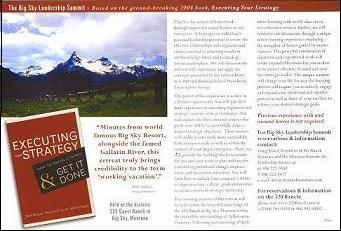
It was a pleasant occurrance for me when several months ago, authors of the extraordinary book "Executing Your Strategy, How to break it down and get it done,"published by Harvard Business School Press earlier this year had asked me to write a comment for their back cover and also to collaborate with them to create a unique and powerful seminar for top leaders and boards of directors.

Our outcome has been, "The Big Sky Leadership Summit" based upon a "Strategic Execution Framework" and Six Domains of Strategic Execution which were conceived, tested, and refined in the Stanford Advanced Project Management Program. While developing our seminar, I found myself integrating several of my own practical ideas. These included a "Blueprint for Change" which is a matrix of questions leading to actions that match the needs of the external and internal environments with strategy, organization, leadership, and other key elements of infrastructure. Another concept is called "TRIADS" which encourages individuals with the necessary competencies and within a disciplined process to informally intervene without management involvement across organizational barriers to join others working on the same projects in efforts to benefit customers.

By putting a combination of the SEF and my own work together, I was able to develop some innovative, practical tools that helped create new models of enterprise that make good stuff happen. Yet, as all of the above was going on, I had an insight that no matter how good our tools, how profound our ideas, how clear our description and instruction, and how competent the leadership and organization of an enterprise, if people don't want to drink our water, and, by extension that of their own enterprises, our collective efforts are for naught. So this leads me to Lou Gerstner's comment when he was realigning IBM's strategy, structure, and culture to change the company's direction from that of a maker of branded products to a provider of custom integrated IT solutions.

"I came to see, in my time at IBM, that culture isn't just one aspect of the game. It is the game! In the end, an organization is nothing more than the collective capacity of its people to create value...no enterprise will succeed over the long haul if those elements aren't a part of its DNA."

And so, considering Gerstner's comments and my own thoughts while putting the seminar together, in my next entry, I'd like to talk not only about the subjects of alignment of leadership culture, structure, and strategy, but of how we can help a horse or horses take a drink, or as we in Montana comment, how do we get a horse to load himself into a trailer and in the process achieve the results we desire.


Tuesday, September 2, 2008

Aligning and Executing Your Strategy toTransform and Sustain Your Business

Hi, I'm Doug Saarel, and welcome to my "Musings from the Mountaintop and beyond". In the following commentaries, my intention is to provide practical advice and to encourage discussion with readers on how to create and sustain an adaptive enterprise; one capable of successfully navigating the changes facing all of us in our modern knowledge-based and technology-driven universe. My emphasis will be on developing and executing effective leadership, strategy, and infrastructure, all within an integrated systems framework. These elements cannot be separated because, in practice, they are all closely related. The following is illustrative.

Recent Research Results are Alarming:
  • More than 50% of down-sizings have resulted in increased costs.
  • Eighty percent of process re-engineering projects have failed to meet their objectives.
  • The majority of quality programs have not substantially improved quality over time.
  • Big projects fail at an astonishing rate; they consume tremendous resources, yet frequently deliver disappointing returns, by some estimates well over half of the time. One middle manager at a top pharmaceutical company stated,"I've been on dozens of task teams in my career, and I've never seen one that actually produced a result".
  • Note: Harvard Business School recently put out an "innovation alert" indicating that over 70% of innovation initiatives have failed to achieve their goals.

The Reasons are Obvious, but the Solutions are not:

  • American business leaders approach improvement initiatives piecemeal.
  • Rather than treat their enterprises as organic systems, they focus on creating the best individual pieces which then don't fit together.
  • Leaders do not take the time to develop the necessary management structures, support systems, and organizational competencies to be successful.
  • They often don't invest in the right projects and execute those projects right.

During my many years of business experience in industry (Johnson & Johnson, The Cleveland Clinic, PepsiCo, Squibb, and as a senior officer of The Coca-Cola Company), as a Chairman of the Board of Overseers and a moderator of executive programs for world leaders at The Aspen Institute, a Senior Fellow at the Wharton School's SEI Center for Advanced Management Studies, and having consulted for fifteen years, I've had the good fortune to develop and try out several tools that have been successful in helping companies transform themselves into enterprises that have created sustainable competitive advantage. It is my intention to share those with you in our deliberations.

Please let me know of your interest and the two or three issues that keep you awake at night.