
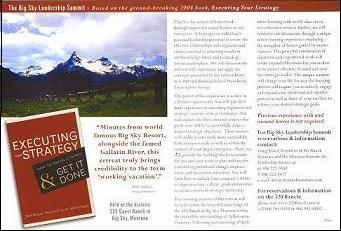
It was a pleasant occurrance for me when several months ago, authors of the extraordinary book "Executing Your Strategy, How to break it down and get it done,"published by Harvard Business School Press earlier this year had asked me to write a comment for their back cover and also to collaborate with them to create a unique and powerful seminar for top leaders and boards of directors.
Our outcome has been, "The Big Sky Leadership Summit" based upon a "Strategic Execution Framework" and Six Domains of Strategic Execution which were conceived, tested, and refined in the Stanford Advanced Project Management Program. While developing our seminar, I found myself integrating several of my own practical ideas. These included a "Blueprint for Change" which is a matrix of questions leading to actions that match the needs of the external and internal environments with strategy, organization, leadership, and other key elements of infrastructure. Another concept is called "TRIADS" which encourages individuals with the necessary competencies and within a disciplined process to informally intervene without management involvement across organizational barriers to join others working on the same projects in efforts to benefit customers.
By putting a combination of the SEF and my own work together, I was able to develop some innovative, practical tools that helped create new models of enterprise that make good stuff happen. Yet, as all of the above was going on, I had an insight that no matter how good our tools, how profound our ideas, how clear our description and instruction, and how competent the leadership and organization of an enterprise, if people don't want to drink our water, and, by extension that of their own enterprises, our collective efforts are for naught. So this leads me to Lou Gerstner's comment when he was realigning IBM's strategy, structure, and culture to change the company's direction from that of a maker of branded products to a provider of custom integrated IT solutions.
"I came to see, in my time at IBM, that culture isn't just one aspect of the game. It is the game! In the end, an organization is nothing more than the collective capacity of its people to create value...no enterprise will succeed over the long haul if those elements aren't a part of its DNA."
And so, considering Gerstner's comments and my own thoughts while putting the seminar together, in my next entry, I'd like to talk not only about the subjects of alignment of leadership culture, structure, and strategy, but of how we can help a horse or horses take a drink, or as we in Montana comment, how do we get a horse to load himself into a trailer and in the process achieve the results we desire.


No comments:
Post a Comment