Tuesday, September 9, 2008

Friday, September 5, 2008

"You Can Lead a Horse to Water..."

The old adage is so true!

It was a pleasant occurrance for me when several months ago, authors of the extraordinary book "Executing Your Strategy, How to break it down and get it done,"published by Harvard Business School Press earlier this year had asked me to write a comment for their back cover and also to collaborate with them to create a unique and powerful seminar for top leaders and boards of directors.

Our outcome has been, "The Big Sky Leadership Summit" based upon a "Strategic Execution Framework" and Six Domains of Strategic Execution which were conceived, tested, and refined in the Stanford Advanced Project Management Program. While developing our seminar, I found myself integrating several of my own practical ideas. These included a "Blueprint for Change" which is a matrix of questions leading to actions that match the needs of the external and internal environments with strategy, organization, leadership, and other key elements of infrastructure. Another concept is called "TRIADS" which encourages individuals with the necessary competencies and within a disciplined process to informally intervene without management involvement across organizational barriers to join others working on the same projects in efforts to benefit customers.

By putting a combination of the SEF and my own work together, I was able to develop some innovative, practical tools that helped create new models of enterprise that make good stuff happen. Yet, as all of the above was going on, I had an insight that no matter how good our tools, how profound our ideas, how clear our description and instruction, and how competent the leadership and organization of an enterprise, if people don't want to drink our water, and, by extension that of their own enterprises, our collective efforts are for naught. So this leads me to Lou Gerstner's comment when he was realigning IBM's strategy, structure, and culture to change the company's direction from that of a maker of branded products to a provider of custom integrated IT solutions.

"I came to see, in my time at IBM, that culture isn't just one aspect of the game. It is the game! In the end, an organization is nothing more than the collective capacity of its people to create value...no enterprise will succeed over the long haul if those elements aren't a part of its DNA."

And so, considering Gerstner's comments and my own thoughts while putting the seminar together, in my next entry, I'd like to talk not only about the subjects of alignment of leadership culture, structure, and strategy, but of how we can help a horse or horses take a drink, or as we in Montana comment, how do we get a horse to load himself into a trailer and in the process achieve the results we desire.


Tuesday, September 2, 2008

Aligning and Executing Your Strategy toTransform and Sustain Your Business

Hi, I'm Doug Saarel, and welcome to my "Musings from the Mountaintop and beyond". In the following commentaries, my intention is to provide practical advice and to encourage discussion with readers on how to create and sustain an adaptive enterprise; one capable of successfully navigating the changes facing all of us in our modern knowledge-based and technology-driven universe. My emphasis will be on developing and executing effective leadership, strategy, and infrastructure, all within an integrated systems framework. These elements cannot be separated because, in practice, they are all closely related. The following is illustrative.

Recent Research Results are Alarming:
  • More than 50% of down-sizings have resulted in increased costs.
  • Eighty percent of process re-engineering projects have failed to meet their objectives.
  • The majority of quality programs have not substantially improved quality over time.
  • Big projects fail at an astonishing rate; they consume tremendous resources, yet frequently deliver disappointing returns, by some estimates well over half of the time. One middle manager at a top pharmaceutical company stated,"I've been on dozens of task teams in my career, and I've never seen one that actually produced a result".
  • Note: Harvard Business School recently put out an "innovation alert" indicating that over 70% of innovation initiatives have failed to achieve their goals.

The Reasons are Obvious, but the Solutions are not:

  • American business leaders approach improvement initiatives piecemeal.
  • Rather than treat their enterprises as organic systems, they focus on creating the best individual pieces which then don't fit together.
  • Leaders do not take the time to develop the necessary management structures, support systems, and organizational competencies to be successful.
  • They often don't invest in the right projects and execute those projects right.

During my many years of business experience in industry (Johnson & Johnson, The Cleveland Clinic, PepsiCo, Squibb, and as a senior officer of The Coca-Cola Company), as a Chairman of the Board of Overseers and a moderator of executive programs for world leaders at The Aspen Institute, a Senior Fellow at the Wharton School's SEI Center for Advanced Management Studies, and having consulted for fifteen years, I've had the good fortune to develop and try out several tools that have been successful in helping companies transform themselves into enterprises that have created sustainable competitive advantage. It is my intention to share those with you in our deliberations.

Please let me know of your interest and the two or three issues that keep you awake at night.

Wednesday, August 20, 2008

You think because you understand one, you must understand two, because one and one makes two, but you must also understand 'and'. ancient Sufi saying

Hi, I'm Doug Saarel and welcome to my on-line newsletter. I look forward to sharing with you a number of ideas developed over several years of life experiences both in business and as an in-depth observer of the developing new sciences. My purpose has been to try and help all of us to better understand what's going on out there and in here regarding our daily lives in this knowledge and technology-driven web-based world in which we live. Further, I hope to share some practical tools which I believe will permit all of us to be more successful in our relationships and in our abilities to achieve the results each one of us desires.

Key to our discussion together is the fact that the universe we inhabit is based much more on randomess than certainty. Unfortunately, we humans are programmed to far better deal with "hard facts" than abstractions. In addition we have been brainwashed for almost three hundred years by leaders of the "Enlightenment" to strongly believe in cause and effect and an analytic mechanical view of the world in which we live. Much of this was reinforced by the Industrial Revolution and its emphasis on a metaphor based upon an economy that was "gaining steam", "putting the gears in motion,"and "a smooth running machine," which transferred from business to all other walks of life.

Metaphors vividly describe our reality and are usually based upon what the technology of the time permits. Those people of an earlier time who believed the earth was flat were no dummies and relied upon the technology of their times to arrive at their conclusions. For a powerful illustration of what things may have been like for Columbus trying to raise funds and royal permission to sail west to find the riches of China, pick up the movie, "1492, Conquest of Paradise" and view the first ten minutes or so. The reality which was then so real certainly changed with what technology permitted Galileo, Copernicus, Decartes, La Place, and Newton to see and understand in their times: A universe that ran with the precision of a clock, each star, planet, molecule, and atom in its static place, all of which ran under a banner of "cause and effect."
Fast forward to May 29, 1919, and the classical physics of the "Enlightenment" fell before the confirmation of Einstein's juggernaut of General Relativity, and slightly later, Neils Bohr's and others' (including Einstein) Quantum Physics. No longer did certainty rule the roost. Randomness reigned! Time on earth and throughout the universe was related to space. And, depending upon your position in the universe and how fast you were moving, your relative time was different from that of your cousin who was on a rocket to somewhere else or living on a planet, the speed and location of which, was different from that of your own.

We discovered that reality was relative and subject to random forces. In fact, we found that everything in the universe is related to everything else and that existance is a tendency based upon observing possibilities and not solid substance (for one credible intrepretation check out the movie, "What the Bleep do we know"). It became clear to those who understood these phenomena that life and everthing connected to it was more like a weather system than a well oiled machine. In the early 1960's Edward Lorenz, an MIT trained meteorologist and early proponent of Chaos Thoery in physics demonstrated figuratively how the beating of the wings of a butterfly in China could literally cause a hurricane to occur in Texas (very slight changes in initial conditions of a non-lnear system expoentially affect its outcome).

But, most of us have had a hard time accepting the new reality in which we exist although its evident confirmation has been around for more than half a century. We are creatures of paradigms and habit. Our reality is based upon our perceptions which, in turn, create our paradigms. We long for the good old days and when things will get back to normal. It's so hard for us to take the leap into a brave new world.

With the above in mind, I have been making progress (which I will share in upcoming editions of this newsletter) to come up with a way to help most of us effectively move from perception of a reality that no longer exists, except in limited forms, and to perceive and embrace the new reality visible to us today and the randomness, chance, and luck that are a major part of it.

Remaining in the past and trying to act on perceptions that are not true lacks integrity, is at best frustrating, and at worst extremely dangerous (Eg. our preparations for 9/11, Katrina, the Challenger and Columbia disasters, and others). However, it is extremely difficult for someone to revise his or her perceptions and beliefs within a practically useful period of time (read Plato's Allegory of a Cave; The Republic, Book VII) . It unfortunately appears from observation that the majority of those who believe in the "old ways", with generally few exceptions, need to die off before a new generation rises to the challenge of a new paradigm based on the "truth" of the present inspired by new technology.

We can't afford to wait! (Integrity and Reality cannot be separated!).


Monday, August 18, 2008

Executing Your Strategy and Achieving Effective Leadership in The New Age of Enterprise

The Big Sky Leadership Summit


Dear Friends and colleagues,


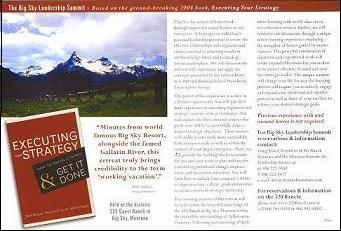
We are pleased to announce a one-of-a-kind seminar based on the ground-breaking 2008 book, Executing Your Strategy, How to Break it Down and Get it Done, by Morgan, Levitt, and Malek published by Harvard Business School Press.


Brought to you in collaboration with Doug Saarel, President & Founder of Sky Ranch Seminars and The Montana Institute for Leadership Science.


This five day retreat delivers breakthrough impact for senior leaders in any enterprise. It leverages an individual's personal leadership potential to create the effective relationships and organizational clarity essential to achieving results in our knowledge-based and technology-driven marketplace.


The power of this seminar is a once in a lifetime opportunity. You will gain first hand experience in executing alignment of six strategic imperatives and systems-wide performance. You will explore the three internal sources that guide your ability to successfully achieve desired strategic objectives. These sources will enable you to work more successfully both interpersonally in a 24/7 world as well as within the context of your larger enterprise. Next, we will provide the building blocks necessary for you and your team to plan and execute essential organizational change, improvement, and innovation initiatives. You will learn how to unlock your company's ability to align structure, culture, goals, and metrics to create consistent and sustainable strategic leadership.


Why you should consider this seminar now: The global economic environment requires that our enterprises execute strategies that result in achieving outcomes that engage the hearts and minds of our employees. This has become very difficult in a 24/7 world. It requires developing organizational clarity concerning the careful allocation of scarce resources and the appropriate development of organizational capabilities. Fifty years of management science no longer provide sufficient tools and frameworks to sucessfully lead today's enterprises. Enterprise systems thinking and effective project and program portfolio management among many others must be achieved by leaders with the knowledge and principles to make them happen.


Recent Results are Alarming:


  • More than 50% of downsizings have resulted in increased costs.


  • Eighty percent of Process Reengineering projects have failed to meet their objecives.


  • The majority of quality programs have not substantially improved qualty over tim


  • Big projects fail at an astonishing rate; they consume tremendous resources yet frequently deliver disappointing returns, by some estimates over half of the time. One middle manager at a top pharmaceutical company stated,"I've been on dozens of task teams in my career, and I've never seen one that actually produced a result."


Note: Harvard Business School recently put out an "innovation alert" indicating that over 70% of innovation initiatives have failed to meet their goals.


The Reasons are Obvious, but the Solutions are not:


  • American business leaders approach improvement initiatives piecemeal.


  • Rather than treat their enterprises as organic systems, they focus on creating the best individual pieces which then don't fit together.


  • Leaders do not take the time to develop the necessary management structures, support systems, and organizational competencies to be successful.


  • They often don't invest in the right projects and execute those projects right.


Why You Need To Attend This Event...


  • You'll learn to leverage the differences among interfaces of leadership, culture, structure, and execution of core strategies through effective project and program portfolio management.


  • You'll learn to focus on the few issues that will get the important stuff done.


  • You'll learn to effectively balance breakthrough thinking and continuous improvement.


  • Collectively, these critical success factors will ensure the organizational clarity and alignment to achieve your strategic business goals.


Facilitated by three world class executive education seminar leaders:


Mark Morgan, William Malek, Doug Saarel


The Big Sky Leadership Summit is for innovative top leaders and board members.


(A downloadable brochure is attached as well as Program and Registration Information.)


Join us in Bg Sky, Montana for this Extraordinary Experience!!


Contact us for Schedule at http://www.skyranchseminars.com/